You look at the clock on the wall. You look at the evening ahead of you. And you make the exact same exhausting mental calculation you made yesterday.
You decide whether tonight is a magnesium night, a melatonin night, or the night you pull out the stronger option hidden at the back of the cabinet. You track the timing with stressful precision. If you take it too early, will you snap awake in the dead of night? If you take it too late, will you spend tomorrow morning trapped in a heavy, medicated fog where your brain feels packed with wet cotton wool? You wonder whether the pill will actually help you stay asleep, or simply pass your brain unconscious for a few hours.
Then you swallow it anyway. You do it because you are entirely tired of waking up at 2:30 a.m. or 3:00 a.m., staring into the pitch darkness while your mind calculates exactly how much of tomorrow’s energy has already been lost.
That is the raw part nobody puts on the supplement label. The nightly decision-making. The bathroom counter full of amber plastic bottles. The quiet, lingering frustration that a basic human biological function has somehow become an industrial project you are forced to constantly manage.
You do not want another pill to swallow. You do not want to build a bedtime laboratory. You simply want to stop treating evening arrival like a science experiment. And that is why the most critical question for your morning energy is not, “Which supplement should I take tonight?”
It is: What is entering my eyes every single evening before I ask my body to settle down?
If you fall asleep easily but keep waking up, the distinction matters
Many people describe their sleep problem incorrectly. They tell their friends, “I just cannot sleep.” But what they actually mean is something far more specific. They fall asleep without a fight. Then they snap awake a few hours later and cannot return to the same depth of rest. They sleep until 2:30 a.m., open their eyes, and feel a sudden wave of alertness — as if a silent signal just went off inside their bedroom.
If falling asleep is not your main struggle, adding another capsule designed around falling asleep misses the entire biological sequence. It forces an internal chemical change while your external environment continues delivering a visual signal that keeps your nervous system prepared for daytime.
You take a supplement because the light of your home tells your brain the day hasn’t ended. You wake up later because the underlying evening signal was never addressed. You increase the dose, change the timing, or buy a newer bottle online. Then you wake up the next morning wondering whether the heavy fatigue in your head is from the broken sleep, or from the chemistry you used to force it.
The routine feels like treatment. But it behaves like a loop. Your cabinet gets fuller while the real input stays untouched.
“Warm mode” changed my phone. It did not change my evening.
You may already have tried the obvious internet fixes. You turned on the warm display setting on your smartphone. You lowered the screen brightness. You enabled night mode on your e-reader.
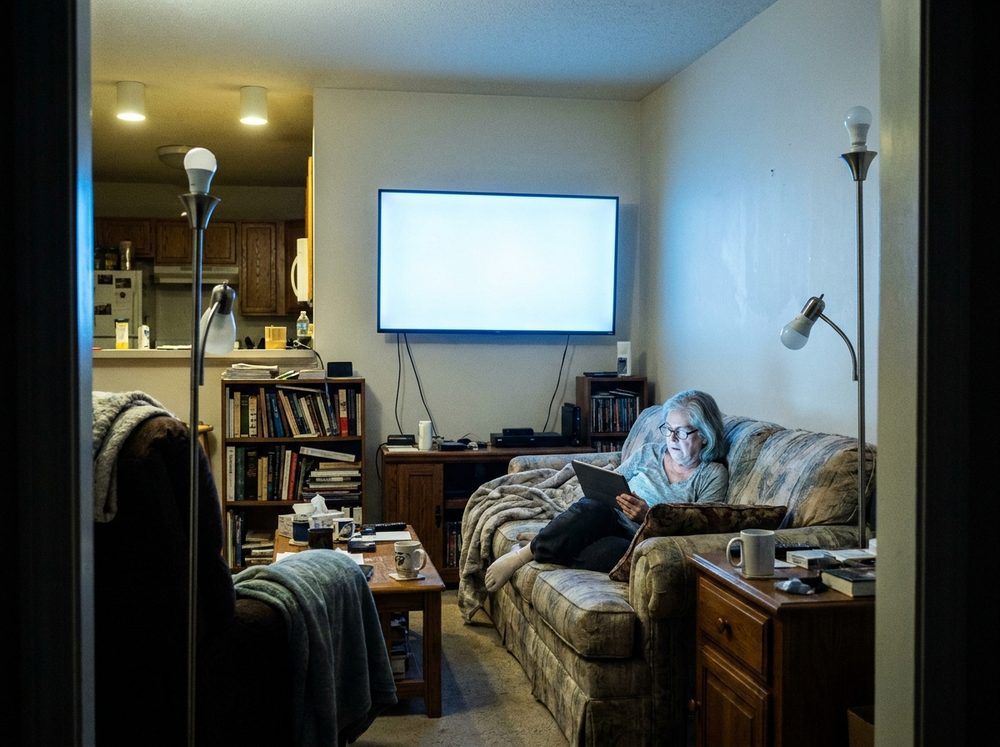
Those settings change the phone. They do absolutely nothing to change the television glowing across the living room. They do not change the reading lamp shining directly into your face beside your chair. They do not change the bright ceiling fixtures, the overhead kitchen lights, or the light bouncing off the walls and glossy table surfaces around you. They do not change the full room signal arriving at your eyes from several directions at once.
Managing one screen is not the same as managing your evening light. Your eyes do not receive one screen. They receive the room.
The Second-Daylight Effect™
Natural daylight does not switch off at full intensity and leave the human nervous system to figure out what happened. The natural environment transitions slowly. The sun dips, the light changes direction, the intensity softens, and the colour spectrum shifts. The eyes receive a specific sunset signal as evening develops.
Modern homes interrupt that biological transition. We keep our rooms illuminated with overhead LEDs, lamps, televisions, tablets, and reflected glare long after the sun has gone down. The result is what I call the Second-Daylight Effect™.
- Television glare
- Reading lamp
- Kitchen overheads
- Phone & tablet
your retinas
The sun has disappeared outside, but the eyes continue receiving a broad, artificial light signal that tells the central clock the day is still fully active. The evening signal is cumulative. The body does not grade each light source separately and decide which one to ignore. Your retinas collect the total visual output of the room.
And you are still trying to counter that massive daytime message with something you swallow.
Why the eye is the point where light becomes biological
The retina is not only a camera for reading text and watching television. It also contains specialised, light-sensitive cells that help the brain track the timing of the day, known as intrinsically photosensitive retinal ganglion cells (ipRGCs).
These specific cells contain a photopigment called melanopsin. They respond strongly to short-wave visible light, specifically in the 400 to 500 nanometer band. Their signals travel directly through the optic nerve and the retinohypothalamic tract toward the suprachiasmatic nucleus — your brain’s central circadian clock.
Light entering your eyes is not merely something you see. It is time-of-day information.

When your eyes receive a strong daytime signal after sunset, your brain processes that information long before any supplement enters your bloodstream and before you start judging whether the chemistry project worked. The question becomes entirely practical: can you reduce the relevant light signal at the eye line, instead of trying to compensate for it from inside a bathroom cabinet afterward?
This is where the narrator and engineering roles become completely clear. I was the person living through this evening environmental trap. My decades as a carrier pilot taught me how to analyse complex visual data, but I did not build the solution. The former fighter pilot who engineered the lens was the person who showed me where the physical solution had to begin.
The lens principle: controlling the final input

In military aviation, a cockpit display cannot simply be turned off because the aviator’s eyes need relief. The instruments must remain visible, the data must stay readable, and the crew must continue operating within a high-density light environment while preserving their physical stamina for the next day’s mission.
The engineering question was not: “How do we make the entire cockpit dark?”
The question was: “How do we manage the light at the final point before it hits the operator’s nervous system? The eyes.”
The pilot didn’t try to redesign or rewire twenty separate aircraft displays. He engineered a precision lens designed to filter out selected alertness-inducing wavelengths at the eye line, leaving the environment perfectly usable. He brought home the lens principle.
I could not rewire my house, change every bulb, or alter my television. But by utilising his lens principle, I could change the entire evening environment at the single point where all those light sources intersect: my eyes.
THE COST OF WAITING
DOING NOTHING FEELS NEUTRAL. IT IS NOT.
It has a real price, and you pay it in daily instalments small enough to miss. Another evening standing in front of the bathroom mirror counting capsules. Another night waking up to perform midnight arithmetic. Another morning running on half power because your bedtime routine didn’t fix your environment.
Waiting is not staying still. It is actively handing over your mornings and evenings to a rigged environment — one day at a time. Why return to the supplement treadmill when a single physical adjustment can manage your environment tonight?
Two approaches to the night
When you look at managing your evening, the strategic choice comes down to how you address the environmental input:

The solution: MyEyeRelief Evening Glasses
The fighter pilot’s breakthrough became the exact foundation for MyEyeRelief Evening Glasses, featuring the proprietary Measured Evening Spectrum Lens.
- Ambient home light
- 99% wavelength filtration400–500 nm
- Natural transition
Instead of forcing you to live in total darkness, MyEyeRelief manages the incoming signal at the eye line. The lens specifically targets the critical 400 to 500 nanometer band, filtering out 99% of sleep-disrupting blue-light wavelengths pouring from your television, lamps, phones, and tablets.
The glasses feature a premium, durable glossy black frame paired with vivid rose-magenta lenses that indicate the precise spectrum of short-wave light being filtered.
What changes for you tonight is immediate. The moment you place them on at 8:00 p.m., the visual environment in your home softens. There is no disruptive cabinet routine to manage. There are no delicate dose calculations to trace, and no lingering hours spent staring at the clock wondering if what you swallowed will wear off before dawn. Your body clock registers sunset naturally while keeping your favourite programs, books, and evening hours completely intact.