THE EVENING INSIDER

5 Reasons People Exhausted by Their Nightly Supplement Routine Are Switching to an Eye-Level Light Solution

Why nothing you swallow changes the light in your living room, and what separates a genuine evening lens from the clear blue-light glasses designed for daytime screens.

Every bottle changes something inside your body.

None of them change the light in the room you are sitting in.

The television. The lamp. The tablet. The kitchen lights.

Separate objects, one destination. Your eyes.

Which means the whole problem has one point where it can actually be managed.

Here is what happens when you manage it there.

THE DISCOVERY: The Evening Lens Built Around That Principle

It is not a supplement.
It is not another complicated routine.
And it does not require you to spend the final hours of the day sitting in darkness.

It is a pair of evening glasses.

Most people’s first reaction is that it cannot possibly be the answer.

That reaction is worth paying attention to, because it points at the exact thing that makes them work.

You put them on after sunset.

You continue watching your programmes, reading your books and sitting beneath your usual lamps.

Then you take them off when you go to bed.

MyEyeRelief Evening Glasses
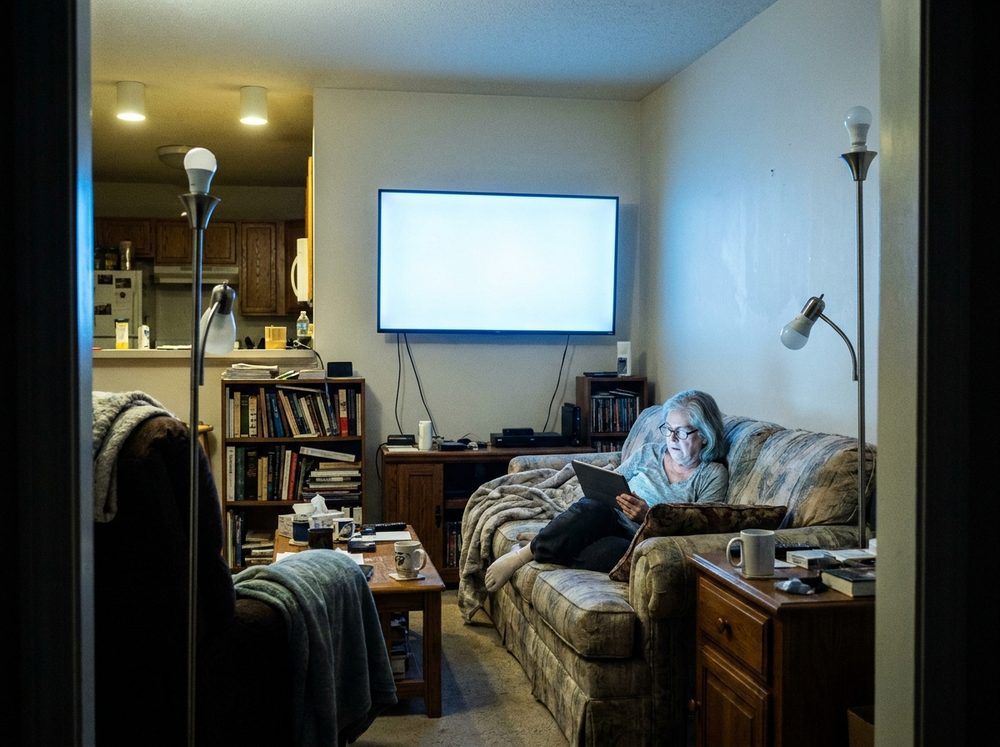
An ordinary Tuesday evening. Telly on, lamp on, cup of tea. Her evening has not changed. What reaches her eyes has.

No replacing every bulb in the house.
No asking everyone else to turn off the television.
No standing beneath the bathroom light at 9:30 p.m. trying to remember what you already took.

No dose. No timing window. No bedtime laboratory.

The idea is simple.

But it raises an obvious objection.

Blue-light glasses have been sold in chemists, airports and office-supply shops for years.
Most are inexpensive.
Most are almost completely clear.

So why would these be any different?

Because almost every pair you have seen was designed for an entirely different time of day, and an entirely different job.

Check Current Availability
Ordinary Clear Blue-Light Glasses Are Built for a Different Job
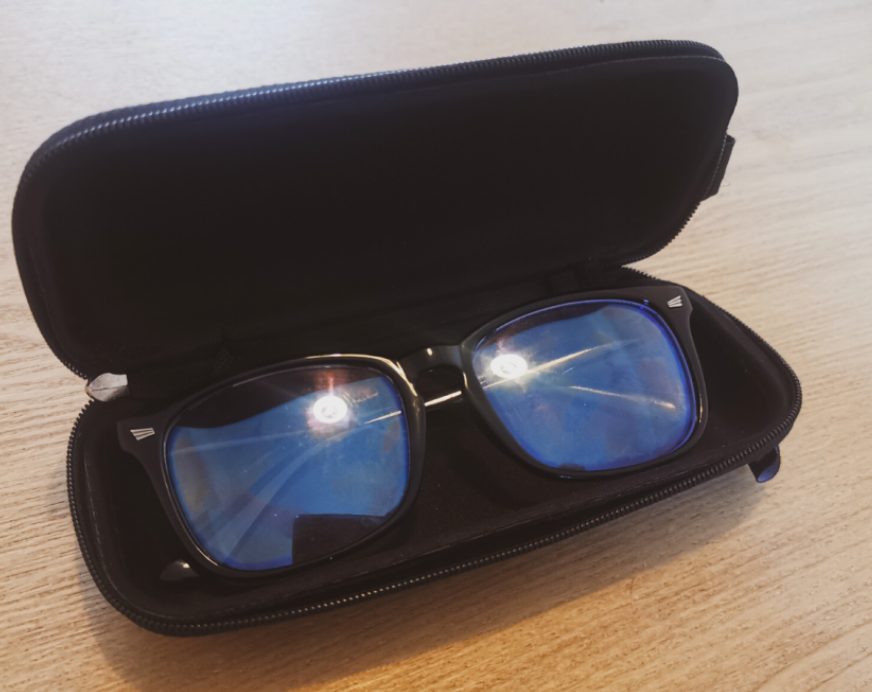
A typical clear blue-light lens. Designed for daytime screens, where preserving normal colour is part of the job.

1. Ordinary Clear Blue-Light Glasses Are Built for a Different Job

Most blue-light glasses were designed for offices.
Computer screens.
Fluorescent lighting.
Long hours spent looking at a monitor.

They are made to keep colours appearing normal so you can wear them throughout the working day without the world looking noticeably different.

Documents remain white.
Screens retain familiar colours.
And the lenses stay clear enough to wear in a meeting.

That makes sense for daytime use.

But every design involves a trade-off.

A lens intended to remain nearly transparent can only make a limited visible change to the light passing through it.

That does not mean clear glasses are defective.
It means they were built for a different purpose.

So the important question is not:

“Do these glasses block blue light?”

Almost every lens affects some portion of light.

The questions worth asking are:

Which wavelengths does the lens filter?
And:
How much of them does it filter?

Those details are especially important after sunset.

Because trying to manage a brightly lit modern evening with a nearly transparent daytime lens is like trying to stop a tidal wave with a screen door.

An evening lens has a different job.

And the first evidence of that difference is impossible to hide.

The Colour Is Not the Compromise. It Is the Mechanism.
The rose-magenta tint is the visible consequence of the lens’s filtering profile, not a decorative styling decision.

2. The Colour Is Not the Compromise. It Is the Mechanism.

The colour is usually the first thing people notice.

It is also the one thing most people have completely backwards.

The vivid rose-magenta tint is not there simply to make the glasses look distinctive.

It is what happens when the lens changes a substantial portion of the light passing through it.

A lens cannot significantly alter visible light while leaving everything looking completely unchanged.

Those two outcomes are physically at odds.

Something has to give.

What gives is the colour.

That is why a clear daytime lens and a genuine evening lens should not look identical.

They are not performing identical jobs.

Put on many ordinary blue-light glasses and the room appears almost exactly as it did before.

That may be ideal at your desk.

But after sunset, an almost invisible change should make you ask an obvious question:

How much is this lens actually doing?

The rose-magenta colour provides an immediate, visible difference.

But colour alone is not proof.

Any company can make a lens pink, orange or red.

The real test is not how dramatic the lens looks.

It is what the lens measurably filters.

It Filters a Specific, Measurable Range
A modern living room after sunset. The evening may feel quiet, but televisions and household LEDs continue producing short-wavelength visible light.

3. It Filters a Specific, Measurable Range

Vague language is common in the blue-light category.

“Blue-light protection.”
“Helps block blue light.”
“Designed for screen use.”

Those phrases may sound reassuring, but they leave the most useful questions unanswered.

Which part of the spectrum?
At what level?
And according to what testing?

The Measured Evening Spectrum Lens™ is built around the 400–500 nanometre range.

These short wavelengths are present in light produced by modern televisions, phones and bright household LEDs.

According to laboratory transmission testing, the lens does not filter a vague or token amount across that range.

It filters 99% of the specified wavelengths across the tested 400–500 nanometre band.

That is the difference between a general marketing phrase and a measurable optical specification.

A stated percentage.
Across a stated range.
Supported by transmission testing.

And that specification matters because the phone is only one part of a modern evening.

Warming your phone display changes the phone.

It does not change the television.
It does not change the lamp beside you.
And it does not change the bright kitchen lights that come on when you stand up to make tea.

Even if you adjust one source, the others remain.

Trying to control them individually creates a growing list of rules.

Dim this.
Switch off that.
Replace those bulbs.
Avoid that room.
Ask everyone else to change what they are doing.

But there is another way to approach the problem.

Stop chasing every source. Look at where they all converge.

The Eye-Level Principle Turns Many Sources Into One Intervention
The same idea in a cockpit. The displays cannot be switched off, so the light is managed at eye level instead.

4. The Eye-Level Principle Turns Many Sources Into One Intervention

Some illuminated environments cannot simply be switched off.

Important displays must remain readable after dark, and surrounding light must be managed without making the space unusable.

The relevant principle is straightforward:

When eliminating every individual source is impractical, selected light can be managed at the point where it reaches the wearer.

At eye level.

It is the same principle used in night-flying cockpits, where the instruments cannot simply be switched off.

An ordinary living room is not one of those environments.

But the convergence problem is remarkably similar.

The television is one source.
The lamp is another.
Your phone is another.
The kitchen lights are another again.

Separate objects.
Different angles.
One final destination.

Your eyes.

That gives the entire problem a single centre.

Instead of fighting a separate battle with every glowing object in the house, you use one wearable intervention at their shared point of arrival.

Put the glasses on.
Watch television.
Read your book.
Make tea.
Let everyone else continue with their evening.

Then take the glasses off when you go to bed.

You have not redesigned the room.
You have changed what reaches you within it.

And that simplicity matters for a reason that has less to do with optics, and everything to do with exhaustion.

It Takes Decisions Out of the Evening Instead of Adding More
The cabinet that grows one bottle, and one nightly decision, at a time.

5. It Takes Decisions Out of the Evening Instead of Adding More

A supplement routine rarely becomes complicated overnight.

It grows gradually.

One bottle helps for a while.
Someone recommends another ingredient.
A different formula promises to work faster.
A stronger option is saved for difficult nights.

Soon, bedtime comes with an entire set of calculations.

What should I take tonight?
How much?
Did I already take it?
Is it too late for something else?
Will I feel foggy tomorrow?

And when the answer disappoints, the search begins again.

Another product.
Another combination.
Another evening spent trying to engineer a basic human function.

A pair of evening glasses does not require a different calculation every night.

You put them on after sunset.
You take them off when you go to bed.

There is no dose to increase.
No combination to remember.
No narrow timing window to miss.
No bottle running empty when you need it.

And nothing else to stand beneath the bathroom light trying to remember at 9:30 p.m.

It does not add another decision to your evening.

It replaces many scattered decisions with one simple physical action.

That may be the most important difference of all.

Because the goal was never to become better at managing an elaborate sleep routine.

The goal was to need less management in the first place.

The Cost of Repeating the Same Experiment

Recurring purchases can seem small in isolation.

One bottle.
One refill.
One more formula worth trying.

But if supplements, sleep aids and related purchases add up to $100 each month, that becomes:

  • $600 in six months
  • $1,200 in one year

And the next $100 does not recover what you have already spent.

It buys another month of approaching the same evening from the same direction.

MyEyeRelief Evening Glasses are a reusable physical tool.

No monthly refill.
No subscription required.
No bottle running empty.

Place them beside your chair and they are ready for the next evening.

In my clinical assessment

The relationship between short-wavelength visible light and the circadian system is well established in modern vision and sleep science.

I reviewed the Measured Evening Spectrum Lens™ and its specified filtration profile. The lens is designed to filter 99% of the stated 400–500 nanometre band at eye level while allowing the wearer to continue using their normal television, books and room lighting.

That is a simple, non-invasive approach to managing the evening light environment without requiring changes throughout the entire home.

Current Batch Availability Notice
MyEyeRelief Evening Glasses

Produced in controlled laboratory batches

MyEyeRelief Evening Glasses

Measured Evening Spectrum lenses are produced in controlled manufacturing runs to maintain their specified optical profile.

Current availability may vary as each completed production run sells through.

What is included in your order

  • One pair of MyEyeRelief Evening Glasses
  • Rose-Magenta Measured Evening Spectrum Lens™
  • The Second-Daylight Reset digital guide
  • The Morning Clarity Blueprint digital guide
  • Free insured priority shipping
  • 60-night money-back guarantee
Get MyEyeRelief Evening Glasses

Try Them Through Your Normal Evenings for 60 Nights

You should not need to reorganise your entire life to decide whether an evening tool is right for you.

Wear the glasses during the evenings you already have.
Watch the programmes you already watch.
Read beneath the lamp you already use.
Make tea beneath your usual kitchen lights.

Then take the glasses off when you go to bed.

You have 60 nights to decide whether they belong in your routine.

If they are not right for you, return them under the terms of the standard 60-night money-back guarantee.

MyEyeRelief glasses are intended as an ambient light-management tool to support a normal evening routine. They are not a substitute for professional medical care or a doctor-prescribed treatment plan.

© 2026 MyEyeRelief. All rights reserved.Free insured priority shipping · 60-night money-back guarantee